 18+
18+
18+
18+
Proven tower rush game tricks, bankroll frameworks, and cash-out tactics for high-volatility crash gameplay — backed by a 97% RTP.
Free demo — no real money. Mirrors the real game's behaviour. May be unavailable in some regions.
Withdrawals at Tower Rush process in as little as 15 minutes via UPI — and keeping that payout speed meaningful depends entirely on how disciplined your in-session decision-making is. Before you touch the cash-out button, the question isn't just when to exit — it's whether you walked into the round with a plan at all.
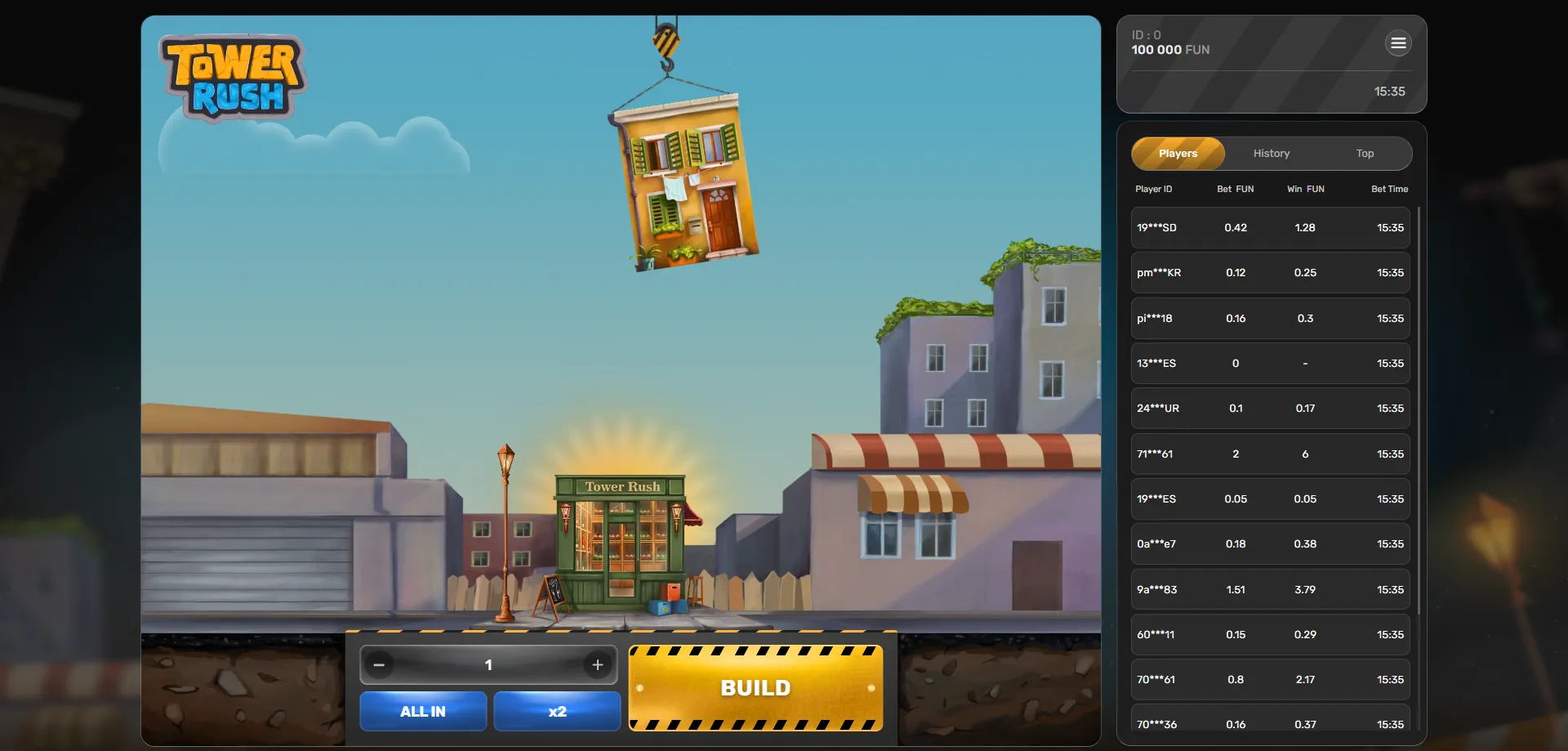
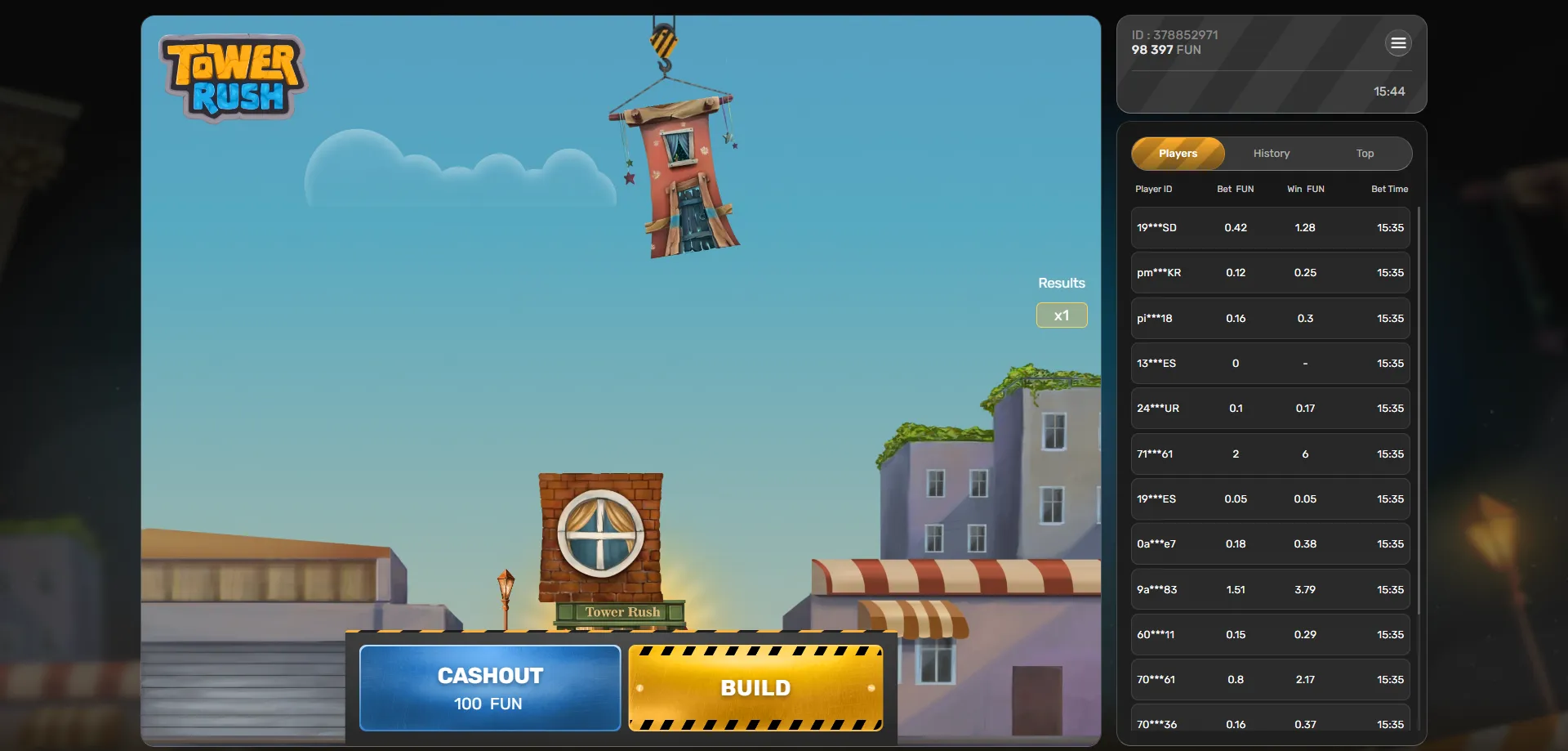
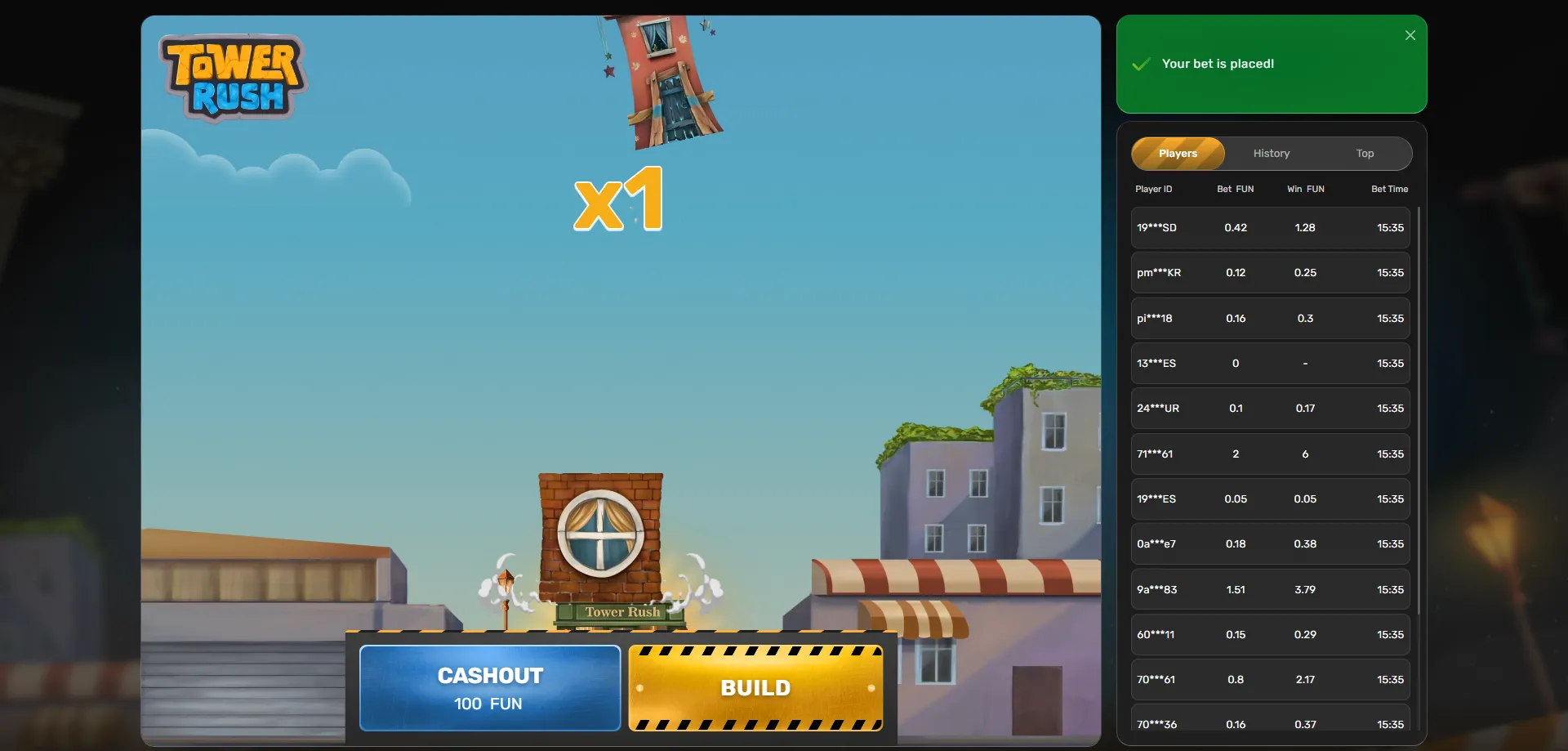
Tower Rush is a crash-format game developed by Galaxsys. A multiplier climbs from 1× as a virtual tower builds upward in real time. You must click cash out before the tower collapses. If it falls before your exit, you lose the stake. Rounds can end in under two seconds or extend past 10×, with no fixed ceiling announced in advance. That transparency is valuable — but it also means the only controllable variable in the room is you.
Luck determines whether a given round crashes at 1.02× or climbs to 20×. Strategy determines how much money you had on that round, what multiplier you were targeting, and whether you stuck to that target or chased a bigger number in the final seconds. Over a single session, luck dominates. Over hundreds of sessions, disciplined decision-making is the only lever a player actually controls.
Players who treat Tower Rush as a pure guessing game will see their bankroll eroded by variance faster than players who bring a defined framework to every session. The 97% RTP is a long-run statistical guarantee — it is not a session-by-session promise. A systematic approach is how you stay in the game long enough for that figure to work in your favour.
The game's certified random number generator determines the crash point before each round begins. You cannot influence when the tower falls. What you control is your stake size, your target cash-out multiplier, whether you use auto cash-out or manual exit, your session budget, and whether you stop playing when you hit a predefined loss limit. That is a meaningful list — and every item on it is addressable before the round even starts.
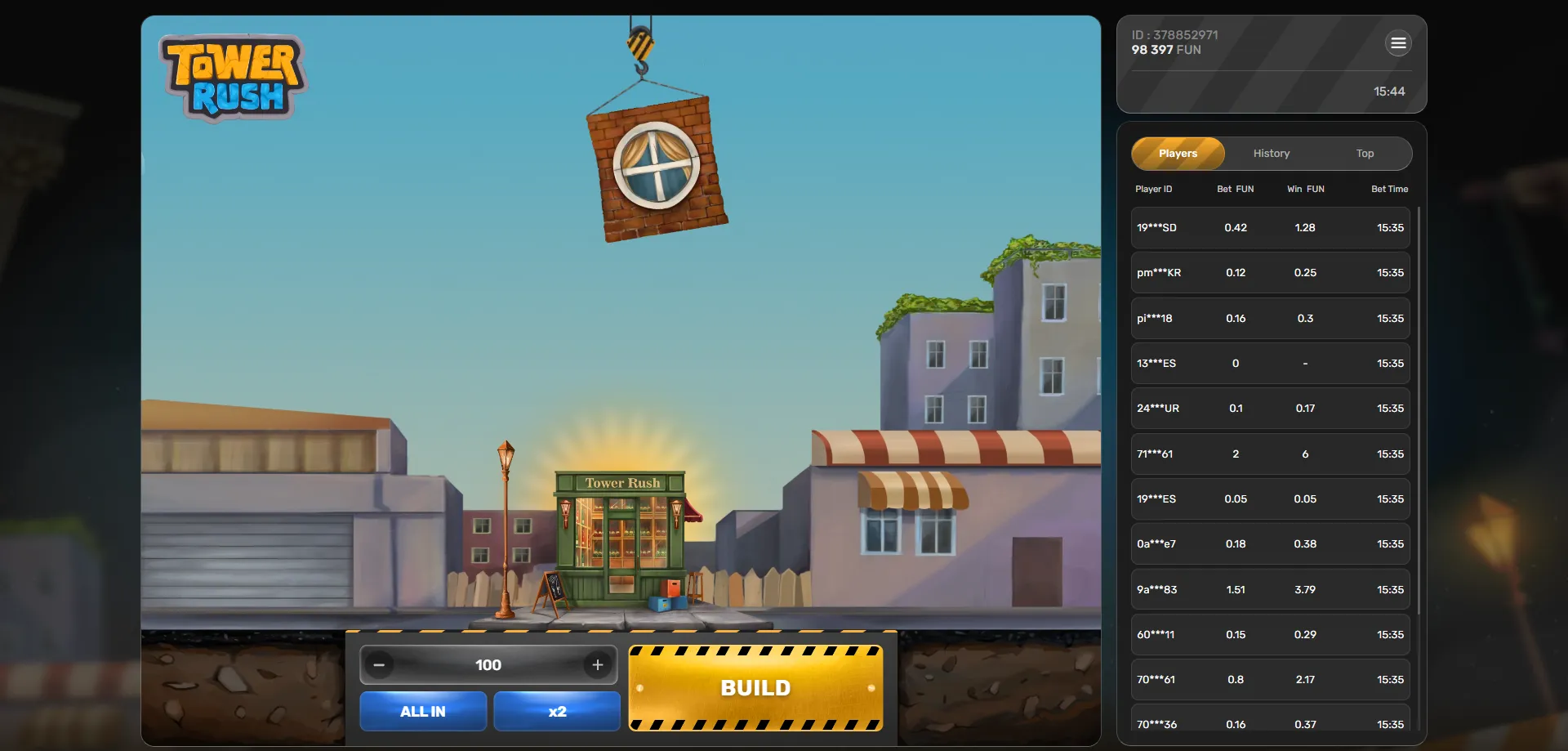
Because Tower Rush offers a single game format rather than a library of slots, your setup decision is about how you configure the game rather than which title to launch. Understanding the RTP and volatility profile is still the first analytical step, and it directly shapes every tactic that follows.
Tower Rush carries an RTP of approximately 97%, which is above the industry average for online casino games. This means the house edge sits at roughly 3%. For context, a standard video slot with 96% RTP returns ₹96 per ₹100 wagered over millions of rounds. Tower Rush returns approximately ₹97. That extra percentage point compounds meaningfully over a long session.
The game is classified as high volatility. In practical terms, high volatility means win frequency is lower than a medium-volatility title, but the wins that do land can carry significant multiplier value. For players using Tower Rush, this means:
Tower Rush does not use a traditional paytable with symbol combinations. The payout for any given round is calculated as: stake × multiplier at cash-out. A ₹100 stake cashed out at 2.5× returns ₹250. A ₹100 stake on a round that crashes at 1.1× before your cash-out is a total loss of ₹100.
The game features three special bonus floors — Frozen Floor, Temple Floor, and Triple Build — triggered randomly by the RNG. These are not purchasable and cannot be anticipated. Their occurrence should be treated as an unexpected upside, never as part of a base strategy. Build your session plan around the standard multiplier range, and treat bonus floors as a bonus.
No cash-out strategy, however well-designed, survives poor bankroll management. This is especially true for a high-volatility crash game where a sequence of early crashes is not an aberration — it is a predictable statistical event that your budget must accommodate.
The most reliable bankroll framework for Tower Rush is fixed percentage staking. Under this method, each round's stake is set at a fixed percentage of your total session budget — typically between 1% and 3%.
| Session Budget | 1% Stake Per Round | 2% Stake Per Round | 3% Stake Per Round |
|---|---|---|---|
| ₹1,000 | ₹10 | ₹20 | ₹30 |
| ₹2,500 | ₹25 | ₹50 | ₹75 |
| ₹5,000 | ₹50 | ₹100 | ₹150 |
| ₹10,000 | ₹100 | ₹200 | ₹300 |
At 1% per round, a complete losing streak of ten consecutive rounds costs you only 10% of your budget. That is painful but survivable. At 3% per round, ten consecutive losses cost 30% — still survivable with discipline, but it will feel more acute. New players and those unfamiliar with Tower Rush's specific variance pattern should start at 1%–2% until they have a realistic sense of the game's crash frequency distribution.
Before every session, define two figures in writing or in a note on your phone:
KYC verification at your chosen casino can add one to three days to your first withdrawal. Submit your documents — government-issued ID, proof of address, and payment method verification — before your first real-money session, not after. Delay here means your winnings sit inaccessible while verification processes. Most India-facing platforms accept UPI and Paytm transactions in INR, with deposits typically completing instantly and withdrawals processing within 15 minutes to 24 hours once KYC is approved.
The following three frameworks represent meaningfully different approaches to stake management during a session. None of them can alter the RNG's output, but each changes your risk profile and how long your bankroll is likely to last.
Flat staking means placing the same fixed amount on every round, regardless of whether the previous round won or lost. It is the simplest and most transparent method. Combined with a consistent auto cash-out multiplier — say, 1.8× on every round — it transforms Tower Rush into a mechanical, emotion-free process.
The mathematics are straightforward. If you cash out at 1.8× and win roughly 55% of rounds (a realistic estimate for a conservative target on a high-volatility game), you are generating positive expected value per round. Flat staking does not try to recover losses faster; it simply ensures that no single outcome, positive or negative, can disproportionately affect your session budget. For players who struggle with impulse decisions, flat staking is the most protective structure available.
The Martingale approach — doubling your stake after each loss to recover the previous loss with a single win — is frequently discussed in the context of crash games. It is worth understanding both its logic and its hard limits.
Logic: If you bet ₹100, lose, bet ₹200, lose, bet ₹400, and win at 2×, you receive ₹800 against a total outlay of ₹700, netting a ₹100 profit. Mathematically, a single win at any point resets you to breakeven.
Hard limits: Tower Rush's high volatility makes multi-round losing streaks statistically common. A streak of six consecutive losses doubles your stake six times — turning a ₹100 starting bet into a ₹6,400 stake on round seven. Casino bet limits and your own session budget will cap this progression before a recovery win arrives. The Martingale is not a strategy that eliminates risk; it is a strategy that concentrates risk into catastrophic single events. Use it only with a strict maximum number of doublings — two or three at most — before resetting to the base stake and accepting the loss.
A modified version — the Fibonacci progression (1, 1, 2, 3, 5, 8…) — scales more slowly and is more sustainable for players who want some recovery mechanism without the explosive stake growth of a pure Martingale.
The reverse pyramid (also called anti-Martingale or Paroli) increases stakes after wins rather than losses. The structure: start with a base stake, increase it by a fixed amount or percentage after each successful cash-out, and reset to the base stake after any loss or after reaching a defined step count (typically three to five steps).
This approach is well-suited to Tower Rush's high-volatility profile because it uses the house's money — accumulated winnings — to pursue larger multipliers, while keeping the base stake constant for protection. A typical three-step reverse pyramid at Tower Rush might look like: ₹100 → win at 2× (stake ₹150 next) → win at 2× (stake ₹200 next) → win or lose at 2×, reset to ₹100. The downside is that a loss at the third step returns only the base risk, but the upside is that win sequences compound without touching your original session budget.
Welcome bonuses, reload offers, and free bet credits at Tower Rush-compatible casinos can extend your session budget and reduce your effective risk per round — but only if you read the terms before accepting them.
The key variables to check before claiming any bonus are: wagering requirement (the number of times you must bet the bonus amount before withdrawing), game contribution (many bonuses contribute only 10%–20% toward wagering when played on crash games versus 100% on standard slots), and time limit (a 30-day expiry on a 40× wagering requirement is difficult to meet at responsible stake sizes).
A bonus that requires 40× wagering with a 10% contribution from crash games effectively demands 400× the bonus value in crash game stakes to clear. At ₹100 per round, that is 4,000 rounds. Assess whether that volume is realistic before your available budget is consumed by the wagering grind.
When a bonus is clearly achievable, integrate it structurally: use it during your session's conservative phase (flat staking at 1.5×–2× auto cash-out) to grind the wagering requirement, then switch to your preferred multiplier target once the bonus is cleared and real cash is confirmed withdrawable. Never use a bonus-funded balance for high-multiplier runs where you intend to cash out immediately — a single win means nothing if the funds are still locked by wagering terms.
Tower Rush uses a provably fair RNG. Each round is a statistically independent event. A tower that has crashed early five consecutive times is not more likely to extend on the sixth round. A tower that reached 8× in the previous round has no elevated probability of doing so again immediately. The provably fair system confirms that crash points are determined before bets are placed and cannot be altered — which also means there is no pattern to detect, no hot streak to ride, and no cold streak to wait out.
The gambler's fallacy — the belief that past outcomes influence future independent events — is the single most dangerous cognitive distortion in crash game play. Players who raise stakes significantly after a losing streak because they believe a big win is overdue are not executing strategy; they are executing a misunderstanding of probability. Tower Rush's RNG does not have memory.
Losing runs in a high-volatility game are not a malfunction — they are an expected statistical feature. The practical tools for maintaining discipline during a losing run are:
Tracking your Tower Rush sessions is not bookkeeping for its own sake. It is the only mechanism that converts subjective impressions — "I feel like I've been losing more lately" — into actionable data.
A basic session log should record: date and session duration, starting balance, ending balance, average stake per round, target multiplier used, number of rounds played, number of successful cash-outs, number of crashes before cash-out, and any deviation from the planned strategy (manual overrides, stake escalation beyond the plan, early session termination).
After ten or more sessions, patterns become visible. You may find that your manual cash-out timing significantly underperforms your auto cash-out sessions — a clear signal to commit to automation. You may find that sessions using a 1.5× target end with smaller losses than sessions using a 3× target, which confirms that the lower target fits your bankroll and volatility tolerance better. Without the log, these patterns remain invisible and you continue repeating the same costly decisions.
Many players who struggle with Tower Rush are not losing because the game is unfair — the 97% RTP is competitive. They are losing because they have no record of where their strategy failed and no basis for adjusting it.
Before every Tower Rush session, run through the following checklist. Each item is a decision that becomes harder to make correctly once a round is in progress and money is at stake:
For a deeper look at how Tower Rush's mechanics work round by round, the Tower Rush game guide covers every step from registration to live cash-out decisions. If you want to go deeper on the numbers before committing a strategy, the Tower Rush RTP and volatility breakdown provides detailed analysis of the 97% RTP and what high volatility means for expected session outcomes.
Register a new account today and receive an exclusive match bonus on your first deposit. Don't miss your chance to conquer the Tower Rush leaderboard!
🚀 Play Now🔒 18+ · T&C Apply · Play Responsibly